H
hi everyone, I hope you are doing well… can you help to answer these questions urgently please.. thanks in advance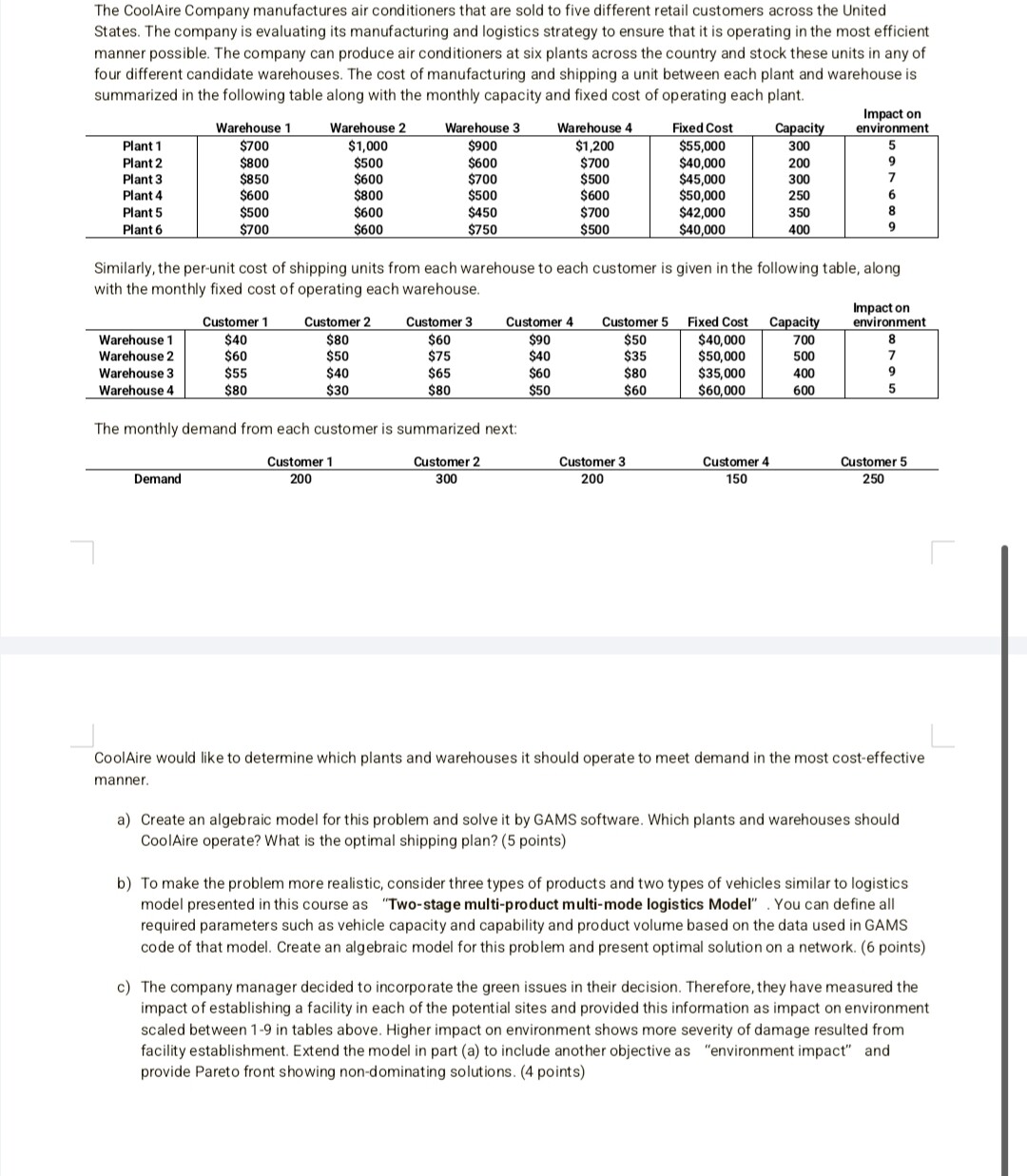
@toto Chances to get help will increase when you put some effort in solving the tasks yourself. When you have done that and you still face challenges, I recommend to share your code here and describe precisely where you need help.
Hope you enjoy the challenge. Good Luck!
Part (a) – Algebraic Model & Solution
We have a two-stage transportation problem with fixed costsfor plants and warehouses (facility location problem).
Sets:
- \( P \) = Plants: \( \{1,2,3,4,5,6\} \)
- \( W \) = Warehouses: \( \{1,2,3,4\} \)
- \( C \) = Customers: \( \{1,2,3,4,5\} \)
Parameters:
- \( \text{pc}_{pw} \) = production & shipping cost from plant \( p \) to warehouse \( w \)
- \( \text{wc}_{wc} \) = shipping cost from warehouse \( w \) to customer \( c \)
- \( \text{demand}_c \) = demand of customer \( c \)
- \( \text{capPlant}_p \) = capacity of plant \( p \)
- \( \text{capWarehouse}_w \) = capacity of warehouse \( w \)
- \( \text{fixedPlant}_p \) = fixed cost of operating plant \( p \)
- \( \text{fixedWarehouse}_w \) = fixed cost of operating warehouse \( w \)
Variables:
- \( x_{pw} \ge 0 \) = units shipped plant \( p \) → warehouse \( w \)
- \( y_{wc} \ge 0 \) = units shipped warehouse \( w \) → customer \( c \)
- \( u_p \in \{0,1\} \) = 1 if plant \( p \) is open
- \( v_w \in \{0,1\} \) = 1 if warehouse \( w \) is open
Objective:
\[
\min \sum_{p,w} \text{pc}_{pw} x_{pw} + \sum_{w,c} \text{wc}_{wc} y_{wc} + \sum_p \text{fixedPlant}_p u_p + \sum_w \text{fixedWarehouse}_w v_w
\]
Constraints:
1. Plant capacity:
\[
\sum_w x_{pw} \le \text{capPlant}_p \cdot u_p \quad \forall p
\]
2. Warehouse capacity:
\[
\sum_c y_{wc} \le \text{capWarehouse}_w \cdot v_w \quad \forall w
\]
3. Warehouse balance:
\[
\sum_p x_{pw} = \sum_c y_{wc} \quad \forall w
\]
4. Demand satisfaction:
\[
\sum_w y_{wc} = \text{demand}_c \quad \forall c
\]
5. Non-negativity and binary for \( u_p, v_w \).
Total demand = ( 200+300+200+150+250 = 1100 ).
From cost inspection:
- Plant 5 has low costs to warehouses 1,2,3; high capacity (350).
- Plant 4 has low cost to W3, W1.
- Plant 2 low cost to W2, W3.
- Warehouse 4 has high fixed cost, but cheap to customers 2,4.
Warehouse 3 has low fixed cost.
A likely open set: Plants 2,4,5; Warehouses 2,3,4 maybe
Part (b) – Multi-product Multi-mode Model
We now have:
Sets:
- Products \( K = \{1,2,3\} \)
- Vehicle types \( V = \{1,2\} \) (e.g., Truck, Rail)
- Plants \( P \), Warehouses \( W \), Customers \( C \)
New parameters:
- \( \text{volume}_k \) = volume per unit of product \( k \)
- \( \text{capVehicle}_v \) = capacity of vehicle type \( v \)
- \( \text{vehicleCost1}_{pwv} \) = cost plant \( p \) → warehouse \( w \) using vehicle \( v \)
- \( \text{vehicleCost2}_{wcv} \) = cost warehouse \( w \) → customer \( c \) using vehicle \( v \)
- \( \text{demand}_{ck} \) = demand of product \( k \) by customer \( c \)
- \( \text{prodCap}_{pk} \) = capacity of plant \( p \) for product \( k \)
- \( \text{storeCap}_{wk} \) = storage capacity of warehouse \( w \) for product \( k \)
Variables:
- \( x_{pwvk} \) = units of product \( k \) shipped \( p \to w \) via vehicle \( v \)
- \( y_{wcvk} \) = units of product \( k \) shipped \( w \to c \) via vehicle \( v \)
- \( u_p, v_w \) binary as before.
Objective:
\[
\min \sum_{p,w,v,k} \text{vehicleCost1}_{pwvk} x_{pwvk} + \sum_{w,c,v,k} \text{vehicleCost2}_{wcvk} y_{wcvk} + \sum_p \text{fixedPlant}_p u_p + \sum_w \text{fixedWarehouse}_w v_w
\]
Constraints:
- Plant capacity per product:
\[
\sum_{w,v} x_{pwvk} \le \text{prodCap}_{pk} \cdot u_p
\]
- Warehouse storage capacity per product:
\[
\sum_{c,v} y_{wcvk} \le \text{storeCap}_{wk} \cdot v_w
\]
- Warehouse flow balance per product:
\[
\sum_{p,v} x_{pwvk} = \sum_{c,v} y_{wcvk} \quad \forall w,k
\]
- Demand:
\[
\sum_{w,v} y_{wcvk} = \text{demand}_{ck} \quad \forall c,k
\]
- Vehicle capacity (per shipment or per total volume) — if per trip, we’d need trip integer variables; here possibly total volume constraint:
\[
\sum_k \text{volume}_k \cdot x_{pwvk} \le \text{capVehicle}_v \cdot z_{pwv}
\]
where \( z_{pwv} \) = number of vehicles used \( p\to w \) type \( v \).
Optimal network diagramwould show flows \( x_{pwvk} \) and \( y_{wcvk} \) aggregated over products/vehicles.
Part (c) – Bi-objective Model
We add environmental impact from opening facilities.
From tables:
- Plant environmental impact \( \text{envPlant}_p \) = given (5,9,7,6,8,9)
- Warehouse environmental impact \( \text{envWarehouse}_w \) = given (8,7,9,5)
Second objective:
\[
\text{Minimize EnvImpact} = \sum_p \text{envPlant}_p \cdot u_p + \sum_w \text{envWarehouse}_w \cdot v_w
\]
objective approach:
Epsilon-constraint method:
Keep cost objective, add constraint:
\[
\sum_p \text{envPlant}_p u_p + \sum_w \text{envWarehouse}_w v_w \le \epsilon
\]
Vary \( \epsilon \) from min possible env impact to max, to get Pareto front.
Min env impact = open plants/warehouses with smallest env scores:
Plant 1 (5), Plant 4 (6) — but check capacity: total cap = 300+250=550, not enough for 1100 demand. So must include others.
Warehouses: W4 (5), W2 (7) maybe.
Pareto front will show trade-off: lower env impact may raise cost
@toto did you try to implement a model in GAMS? I doubt that anybody is willing to translate your markdown code for you.
I tried to apply it in the program, but my knowledge of using the software is limited. I watched YouTube tutorials, and I understand the software, but the application is difficult for me. The results are unclear, so I couldn’t solve it correctly, even though I urgently need the solution.
I implement it on the software، but it doesn’t run accurately.. can i sent the word doc. ?